Resin charms & flatback cabochons
The full stock range with sizes, pack counts and per-SKU quoting.
Read guide →Updated 8 October 2026 · by the Qula Craft Sourcing Team — the people who quote and pack these lines every week.
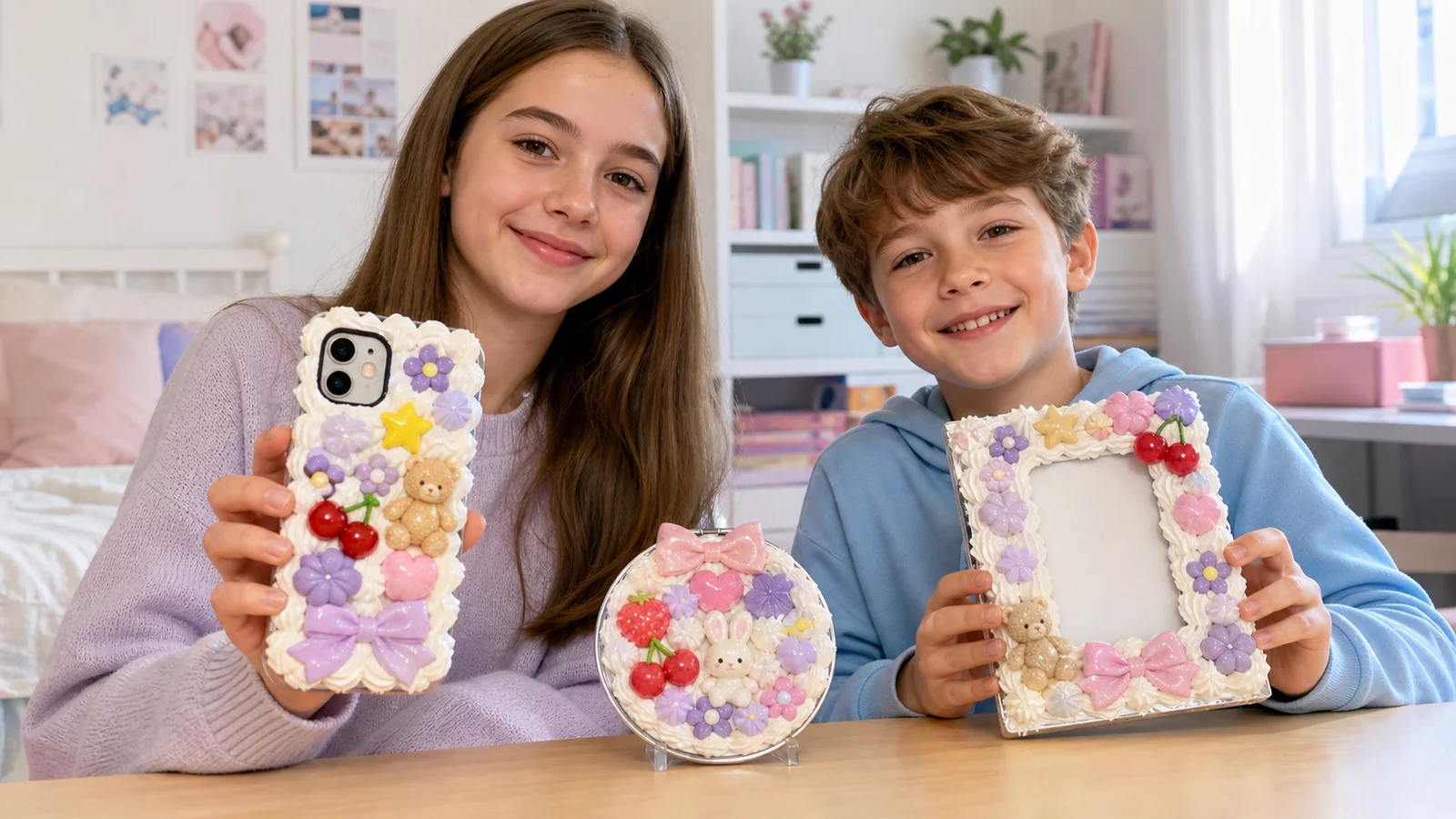
Decoden works by gluing pieces onto a curved surface, usually over a whipped-cream base. A piece with a flat reverse side sits flush and bonds across its whole footprint. A rounded or 3D piece touches the glue at one point, sticks out, and is the first thing to catch on a pocket and pop off.
That is why the useful phrase when sourcing is “flatback cabochon” rather than “charm”. Charm can describe a drilled piece, a looped pendant or a flatback component. For a phone case, request a reverse-side photo and confirm a flat backing for each selected SKU; the category name alone does not establish suitability.
Beginners buy one size and wonder why the result looks like a sticker sheet. A case that reads as a composition uses three tiers. Use the ranges below as layout suggestions, then check the actual dimensions of your selected pieces:
| Tier | Rough size | Count per case | Job |
|---|---|---|---|
| Focal | ~30–36 mm | 1–3 | The piece the eye lands on; sets the theme |
| Mid | ~18–25 mm | 5–10 | Carries the theme around the focal piece |
| Filler | ~12 mm and under | 20–40 | Closes gaps so no base shows through |
Filler pieces are where most of the count goes. Pack counts and minimum orders vary by SKU; use the confirmed pieces per pack and your trial layout to calculate quantities rather than assuming every bag contains 100 pieces.
Cast resin is the right process for these shapes, but it has a physical limit worth understanding before you order at scale. Mixing the two parts causes an exothermic reaction that generates heat, and that heat plus the casting compounds gradually degrade the mould — a flexible mould typically yields between 25 and 100 castings before fine detail softens.
Practical consequences:
Both materials turn up in decoden supplies and they are not interchangeable. Polymer clay is PVC-based and cured at around 129–135 °C, which is why clay slices arrive as fully hardened pieces with the pattern running right through them. Cast resin takes finer moulded detail and a glossier finish.
On a phone case the practical split is: resin for the focal and mid pieces where moulded detail is the selling point, and clay slices for scatter and gap-filling where you want pattern and colour without paying for detail nobody will look at closely. Mixing both is normal — most finished cases in our reference photos use resin shapes over a clay-slice confetti layer.
Decoden buyers split into three groups, and they want different things from the same catalogue. Kawaii food pieces — jelly beans, strawberries, cookies, cake slices — are the steady sellers for case makers. Ocean and animal sets (crabs, starfish, dolphins, frogs) move for kids' channels and summer ranges. Seasonal shapes carry a short, sharp window: order Christmas pieces a season early, because a decoden case takes hours to build and sellers buy the supplies long before the gift rush.
One useful note for kids' channels: everything here is decorative and non-edible, and must be labelled that way. If you sell into retailers that ask for paperwork, batch test reports for EN 71, ASTM F963, CPC and REACH are available on request — our safety labeling guide covers the wording that keeps you out of trouble.
Build a proposed starter assortment, then request the current minimum order and pack count for each SKU. The earlier 19-design example does not describe the full current catalogue. A useful selection plan is:
That is five to seven designs to discuss, rather than a guaranteed five-to-seven-bag minimum. Confirm quantities, flatback style, current-batch samples and packing in the quotation before placing the order.
Send the theme and roughly how many cases per month. We put together a focal / mid / filler mix from stock, quote by the bag with carton data, and can send current-batch samples on the detailed pieces before you commit.
The full stock range with sizes, pack counts and per-SKU quoting.
Read guide →Review non-food labeling, small-parts warnings and documentation questions for your intended sales market.
Read guide →Where each line fits — decoden, nail art, jewellery, slime, party.
Read guide →