Glitter, sequins & fillers
The full stock range including bingsu, hollow stars and holographic paillettes.
Read guide →Updated July 2026 · by the Qula Craft Sourcing Team — the people who quote and pack these lines every week.
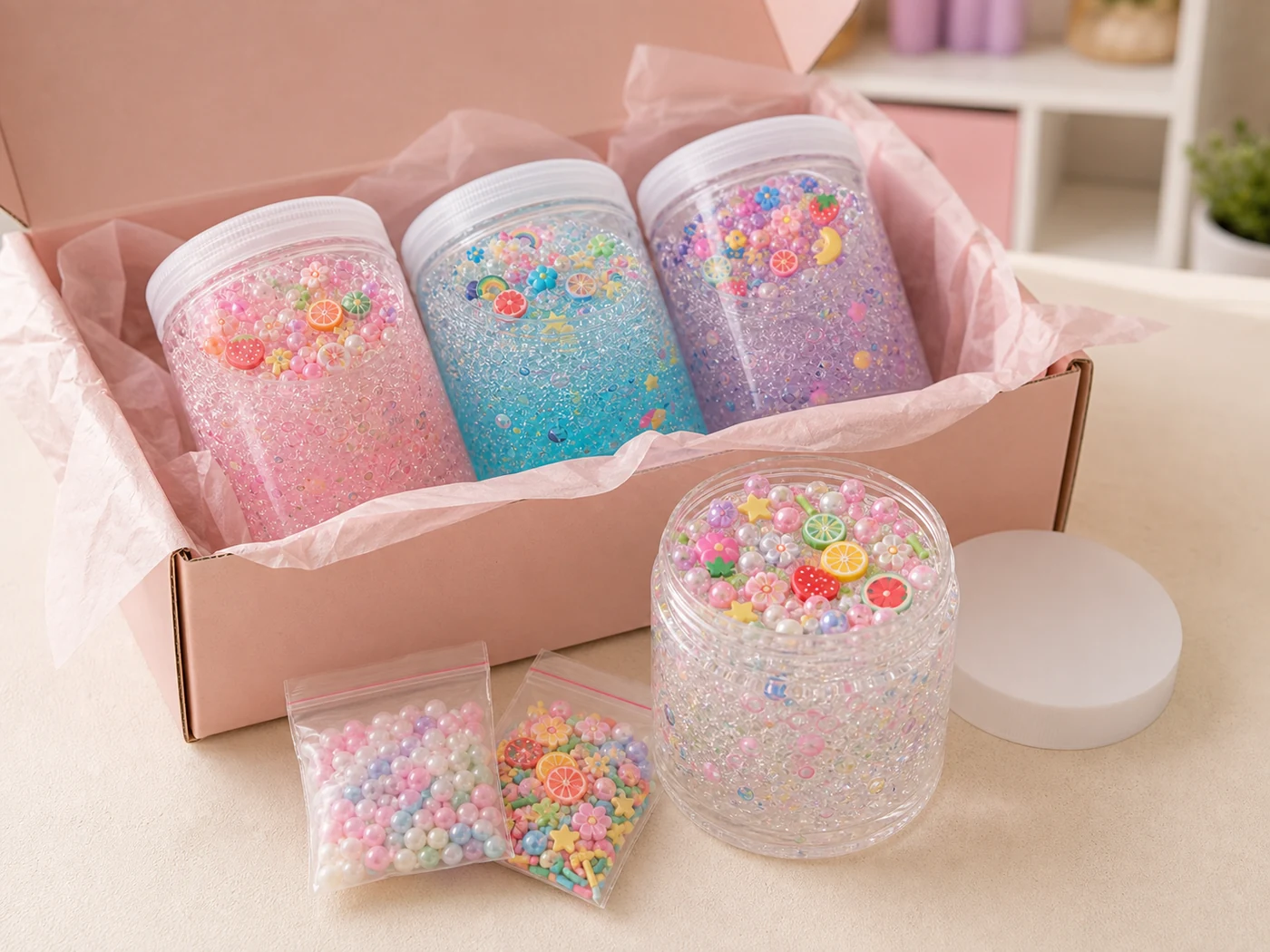
| Filler | Material & feel | What it does to the slime | Watch out for |
|---|---|---|---|
| Bingsu beads | Soft PET strands, iridescent, very light | Fine crunch with almost no weight; keeps stretch | Colour can migrate into pale bases — test before a big batch |
| Fishbowl beads | Hard rounded plastic | Loud, obvious crackle; adds visible volume | Sinks and pools at the bottom of a jar on the shelf |
| Foam balls | Expanded foam, various diameters | Turns the base into floam; cheapest way to add bulk | Changes the product category — floam buyers and slime buyers differ |
Our stock bingsu is listed as PET. That matters more than it sounds: PET carries resin identification code 1 and is practically insoluble in water, which is why the strands hold their shape in a wet slime base instead of softening into mush the way some cheaper substitutes do.
Both of our bingsu packs are 500g per bag, minimum one bag. Because bingsu is so light, 500g is a lot of visible volume — considerably more jars than 500g of a dense filler would cover. Rather than guess at a jars-per-bag figure that depends entirely on your dosing, do it the reliable way:
This is the same reason we sell trial sizes on the sprinkle side of the catalogue: guessing dosage from a photo is the fastest way to end up with dead stock.
The single most common complaint about any iridescent filler is colour migrating into a pale base after a few weeks on a shelf. It is not always visible on day one, which is what makes it expensive — you find out after the batch has shipped.
Test it in 20 minutes before you commit: put a pinch of filler into your palest base, seal it, leave it somewhere warm and check at 24 hours and again at a week. If the base has picked up a tint, keep that filler for saturated colours only. Do this per batch, not per supplier — pigment lots change.
Fillers change the texture and sound of the slime and get mixed through. Toppings sit on the surface, sell the photograph, and are usually clay or resin. Confusing the two is why some jars look great and feel wrong.
Clay sprinkles are a topping, not a filler, and there is a physical reason: polymer clay is a PVC-based material that cures at roughly 129–135 °C — it is a fully cured solid by the time it reaches you, so it holds its printed detail on the surface where buyers see it, rather than being worked through the base where the detail is wasted.
You do not need every filler. Most shops that reorder steadily run one crunchy filler, one visual topping range and one seasonal set, then rotate the seasonal slot four times a year. Concretely: one bingsu pack for the crunch, a clay sprinkle mix for the surface, and a themed charm set that changes with the calendar.
Everything above ships from one bag, so you can build that three-part range for a first order without committing to bulk on any single line — then scale only what sells through.
Tell us the texture you sell — light crunch, loud crackle, floam — and the base colour. We quote by the bag with carton data attached, and can send trial quantities before you commit to a season.
The full stock range including bingsu, hollow stars and holographic paillettes.
Read guide →Compare clay slices and resin charms for slime by texture, dosing, sample checks and sourcing needs.
Read guide →Plan slime supplies, decorative add-ins, trial quantities and packaging before placing a wholesale order.
Read guide →