Best Packaging Options for DIY Craft Supplies
Compare bags, bottles, jars, compartment boxes and gift boxes.
Read guide →Updated August 2026 · by the Qula Craft Sourcing Team
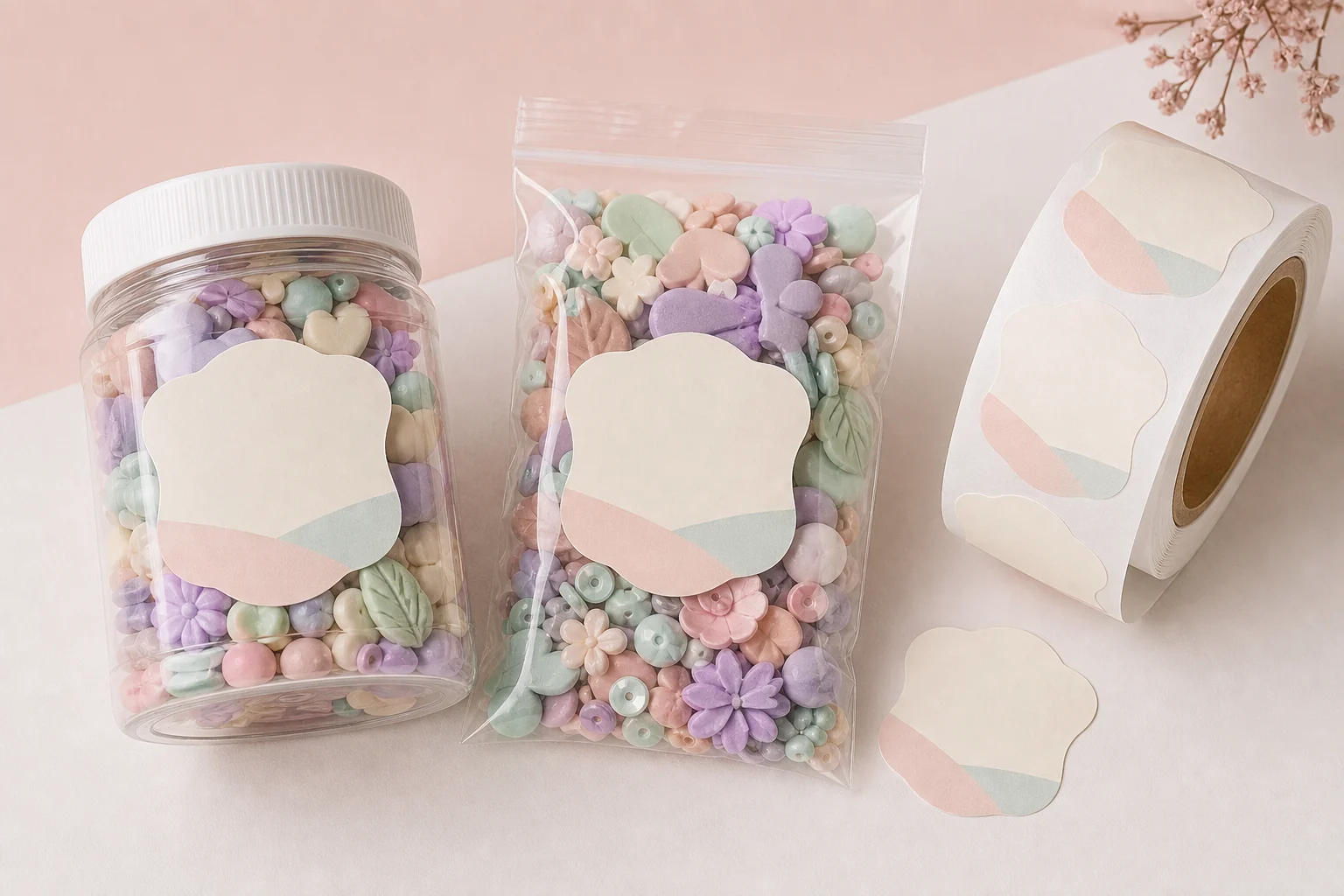
Packaging has its own production economics: printing plates or cylinders, color setup, cutting dies, material minimums and press time. A supplier may be able to pack one bag of stock charms but cannot economically start a custom film run for the same quantity. Treat product MOQ and packaging MOQ as separate decisions.
The practical question is not “How do I force the printed-pouch MOQ lower?” It is “What is the lightest branding layer that makes this batch ready for its channel?”
| Stage | Format | Best use |
|---|---|---|
| Validate | Stock bag, bottle or box + applied label | New product, new count or online-only launch |
| Merchandise | Stock container + header card, insert or belly band | Craft fairs, boutiques and peg displays |
| Standardize | Shared branded pack across several SKUs | A stable range with variable product labels |
| Scale | Fully printed pouch, bottle or box | Proven volume and predictable replenishment |
This is not a compromise in professionalism. A clean stock pouch with a well-designed header card can look intentional, scan correctly and be replaced in the exact quantity the test needs.
Choose the container from the product’s weight, shape, dust, visibility and display method. Then use as few pack sizes as possible across the range. Shared dimensions simplify label templates, cartons, photography and reorder planning.
Request a filled sample, not only an empty package. A bag that looks large enough may bow, hide the product below a header card or leave too much empty space. For sequins and clay slices, test seal integrity and migration into zipper tracks. For resin charms, check whether edges puncture thin film in transit.
Reserve fixed zones for brand, product name, variant, net quantity, warnings, business identity, origin information and barcode. Keep variable data on a label when possible; that lets one branded pack serve several SKUs without reprinting the whole package.
If a retailer or marketplace requires a product identifier, plan it early. GS1 distinguishes the consumer “each” from inner packs and cases, because each packaging level plays a different role in ordering, selling and scanning. Do not put a case code on the consumer pack or reuse one product’s identifier on another variant.
Putting your logo or domestic business address on an imported item does not make it domestically made. The FTC’s Made in USA guidance explains that unqualified U.S.-origin claims require the product to be all or virtually all made in the United States, while imported products are also subject to Customs origin-marking rules.
Ask the importer or compliance adviser responsible for your market to confirm the final wording and placement. Keep claims such as “non-toxic,” “food safe,” “eco-friendly” or “certified” off the artwork unless the exact product, evidence and market support them. Packaging is difficult to correct after thousands of copies are printed.
Approve both a digital proof and, when the risk justifies it, a physical pre-production sample. View it filled, sealed, hanging or shelved the way a customer will encounter it.
Upgrade when the product definition is stable, the sales channel is known, the artwork has survived a real launch and the expected reorder can consume the print run before information becomes obsolete. Include packaging already on hand in that calculation; cheap unit cost is not a saving if half the bags remain after a SKU changes.
Ask for separate quotes at two realistic print quantities and compare total cash, storage, spoilage risk and lead time—not only price per bag. A slightly higher unit cost can be rational when it keeps more cash available for the products customers actually reorder.
See the packaging format comparison for bags, jars, bottles and boxes, then use the private-label collection guide to keep product and packaging decisions aligned.
Send the product, fill quantity, sales channel, SKU count, artwork status and destination. We will compare stock-pack branding and full custom options as separate lines.
Compare bags, bottles, jars, compartment boxes and gift boxes.
Read guide →Plan packaging around a coherent, reorderable range.
Read guide →Validate demand before adding a large print commitment.
Read guide →