Best Packaging for DIY Craft Supplies: Bags, Bottles, Jars & Boxes
Compare bags, bottles, jars and boxes by pack requirements, sample checks, quotation details and freight measurements.
Read guide →Updated September 28, 2026 · by the Qula Craft sales team
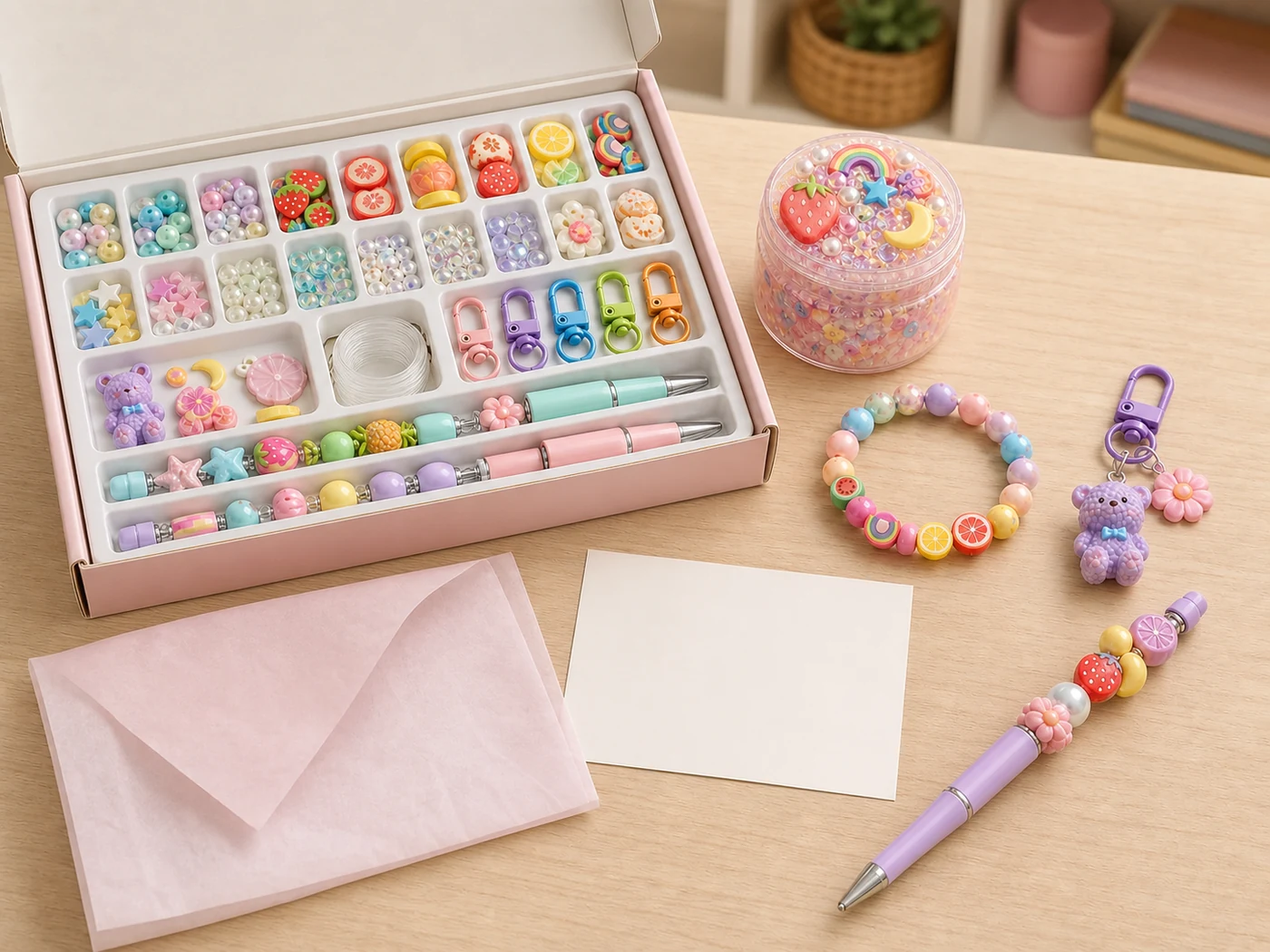
Bulk craft supplies are cheap per kilogram and expensive per gram at retail — that spread is your business. An illustrative walk-through (numbers vary by product and market; treat as structure, not a promise):
| Step | Example |
|---|---|
| 1kg bulk mix | one wholesale line item |
| Split into 15g bottles | ~65 branded units |
| Typical craft retail price | $2.5–$4.5 per bottle in US/EU marketplaces |
| Your costs per unit | product + bottle + label + fill labor + freight share |
The lesson: packaging and freight — not the product itself — decide your unit economics. Choose the format before you negotiate the mix. Our packaging comparison guide · Slime business starter supply checklist covers cost bands per format.
First collections fail by going wide. A tight launch that reads as a “range” on one shelf:
Every SKU shares the same bottle, label template and font — only the product and one color band change. That is what makes a $500 label print run look like a brand.
| Tier | Format | Fits |
|---|---|---|
| Entry | Labeled OPP / ziplock bag | Etsy, markets, refill culture |
| Standard | PET bottle or wide-mouth jar + wrap label | Amazon, boutiques, nail supply shops |
| Kit | Compartment box, 6–12 wells | DIY kits, subscription boxes, gifting |
| Premium | Printed gift box + insert | Holiday sets, B2B corporate gifts |
You can mix tiers: bulk bags for your production line plus bottles for retail. Details and photos on the private label packaging page.
Reprinting labels because a warning was missing is the most avoidable cost in this niche. Minimum content: brand, product name, net weight, “Decorative craft material — not edible”, “Small parts — choking hazard, not for children under 3” where relevant, material note, batch/SKU code, your contact, barcode for marketplaces. Full wording templates are in the safety labeling guide.
Qula Craft accepts enquiries for custom focal beads, 3D flatback charms and assembled accessories such as keychains, bracelets and necklaces. Tell us whether you need loose components for your own workshop or finished pieces with packaging. This changes the specification, sample review and quotation.
Start with a sketch, reference photo or existing sample. We review the suitable material and process with you; a photograph alone cannot establish whether a particular finish or construction can be reproduced.
A digital proof is a design confirmation image or drawing. Agree the dimensions, colors, hole positions, layout and revision scope that it needs to show. It helps confirm the design before the next step; it does not replace a physical sample where one is needed.
A prototype helps review a new shape or construction. A pre-production sample is used to approve the agreed material, finish, assembly and packaging before the bulk run. The appropriate stages, fees, revision allowance and timing are confirmed for your project. A stock sample and a new custom sample are different requests.
If new tooling is needed, discuss the tooling charge, any exclusive-use requirement, ownership, storage and transfer arrangements before proceeding. Customer-specific tooling terms are subject to written agreement; paying a tooling charge is not a substitute for agreeing those terms.
The schedule starts with a complete brief and feasibility review, followed by the agreed proof and sample stages, approval, production, packing and shipping. A new shape or assembled accessory may require different work from a stock product with a new label. Request a project-specific schedule by email rather than applying a stock-sample lead time to custom development.
Email your brief to sales@qulacrafts.com or use the custom development page. Include reference images, component or finished-product format, dimensions, material preference, quantity, target market, intended use, packaging, any testing requirements and your preferred delivery date.
A tight 6–8 SKU launch in labeled bags or bottles. That is enough to look like a range on a shelf or storefront without spreading budget across slow movers. Expand from your first reorder data.
Brand name, product name, net weight, a non-food warning, a small-parts choking warning if kids may access it, material note, batch or SKU code, and your business contact. Marketplace sellers also need a scannable barcode (GTIN).
Timing depends on the design, tooling, sample revisions, assembly, packaging and shipping route. Email your requirements and target delivery date so we can confirm a project-specific schedule.
Compare bags, bottles, jars and boxes by pack requirements, sample checks, quotation details and freight measurements.
Read guide →Work backward from your launch date to plan samples, packaging, production and shipping for seasonal collections.
Read guide →What the deposit covers on custom work, and why tooling is hardware rather than a design fee.
Read guide →