Fake Sprinkles for Slime: Polymer Clay Slices vs Resin Charms
Compare clay slices and resin charms for slime by texture, dosing, sample checks and sourcing needs.
Read guide →Updated October 14, 2026 · by the Qula Craft sales team
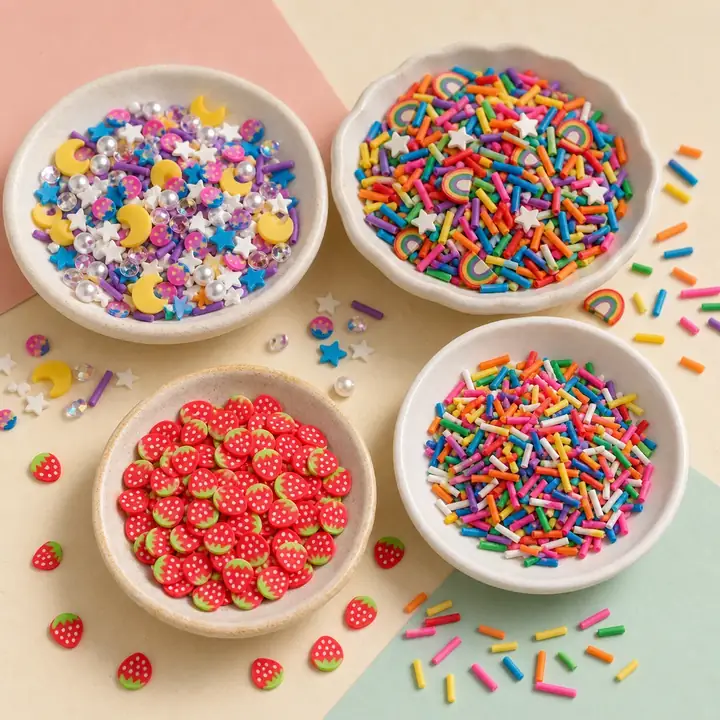
Choose dimensions around the finished product and check the exact SKU with a sample. A photograph does not establish slice size, thickness or suitability for your application.
| Application | Measurements to confirm | Sample check |
|---|---|---|
| Nail art or small cavities | Slice width and thickness | Check the available surface or cavity and the intended finish. |
| Slime toppings | Slice dimensions and mix composition | Try the mix in your actual slime formula and review appearance and texture. |
| Shakers or tumblers | Largest piece and thickness | Check the opening, internal clearance and intended liquid or medium. |
| DIY kits or decoden | Dimensions of each component | Check the layout, attachment method and packaging with a sample. |
For mixed-size themes, specify the size range and shape ratio against an approved sample. For a seasonal example, review YX4075 St. Patrick’s Day polymer clay slices with shamrock and green hat motifs, then confirm the pack weight and dimensions for your application.
Confirm whether the quotation is per bag, pack or kilogram before comparing prices. The following are arithmetic examples using 1,000g of usable material, with no filling loss. These fill weights are planning inputs, not standard pack sizes or recommended doses.
| Example fill weight | Complete packs per 1kg | Material remaining |
|---|---|---|
| 10g | 100 | 0g |
| 15g | 66 | 10g |
| 20g | 50 | 0g |
| 25g | 40 | 0g |
Complete packs = usable material weight ÷ target fill weight, rounded down. For example, 1,000g ÷ 15g gives 66 complete packs and 10g left over. Check the filled volume with your own container and sample. Use a trial fill to estimate handling loss and any extra material needed to meet your agreed fill-weight tolerance. Net weight does not establish a fixed piece count.
Catalog mixes let you start from existing fruit, heart, star or holiday designs. Confirm current availability and compare a sample with your requirements. Custom shapes need a design review and sample approval; feasibility, minimum quantity and timing are confirmed for each project.
Ask for the material description, finish and sample for the exact product code, especially when a mix includes several types of decoration. A pattern or product photograph does not establish resistance to heat, color transfer or compatibility with a resin system.
For resin inclusions, review a sample in the intended resin and follow the resin supplier's mixing and curing instructions. Confirm the finished appearance and performance before bulk production. Compare custom options using the quoted design, sampling, tooling, quantity and packing requirements; do not assume one material is always cheaper.
One complete message beats five rounds of back-and-forth. Include: application (slime / nail art / kits), size band, theme or reference photo, quantity in kg, packaging format (compare options here), private label needs, destination country and target date. Browse the polymer clay sprinkles range to reference specific mixes by name.
Send the selected SKUs, quantity, dimensions to confirm, packaging and destination so we can review the requirements and prepare a quotation.
With no filling loss, 1,000g makes 100 complete packs at 10g, 66 at 15g with 10g left over, 50 at 20g, or 40 at 25g. These are calculation examples, not recommended fill weights. Estimate usable weight and filling loss from a trial with your selected mix and container.
Start with a sample and estimate the quantity from your planned fill weight and number of retail units. Confirm the minimum quantity for each SKU; custom shapes and mixes may have different minimums.
Catalog designs depend on current availability. Custom shapes add design review and sample approval before production. Request the sampling, production and shipping schedule with your quotation.
Compare clay slices and resin charms for slime by texture, dosing, sample checks and sourcing needs.
Read guide →Review non-food labeling, small-parts warnings and documentation questions for your intended sales market.
Read guide →Why unit price is not the number that decides your margin, and how to get a real freight figure.
Read guide →